

Our Commitment to Ethical Business and Sustainable Jewellery
Seven commitments we can stand behind, how you can check each one, and the things we

If you have researched ethical diamonds, you will have met the phrase conflict free, usually alongside a mention of the Kimberley Process. It is a genuine achievement and a sensible floor. But it is a floor, not a ceiling, and a well-informed buyer today can ask for a great deal more. Here is what conflict free really covers, what it leaves out, and what modern diamond traceability actually looks like.
At a glance
Launched in 2003 after a global campaign against so-called blood diamonds, the Kimberley Process is an international certification scheme designed to stop the trade in rough diamonds that fund armed rebel movements against legitimate governments. It brought together governments, industry and civil society, and it genuinely reduced the flow of those stones into the market. That is a real and worthwhile achievement, and it deserves credit.
The catch is in the definition. The scheme uses a narrow meaning of conflict diamond: only rough stones financing rebel groups. That leaves a great deal outside its scope.
Because the definition is so specific, the Kimberley Process says nothing about several things a thoughtful buyer might care about: the working conditions and pay of the people who mine the stones, abuses linked to governments rather than rebels, smuggling across borders, or anything that happens after a diamond is cut and polished, which is where most of a stone's life before it reaches a ring actually happens. A diamond can be entirely Kimberley-compliant and still have a story you would want to know more about. This is not a reason to distrust the scheme; it is a reason to ask for more on top of it.
Want the plain-English version of how we source? Our ethical and responsible sourcing page sets out what we can tell you about the stones we sell, and the free Diamond and Gemstone Guide covers certification in detail.
The good news is that the tools available now go well beyond a single certificate. Between them, they let the industry, and increasingly the customer, follow a diamond much further along the chain:
You do not need to master any of this to buy well. You only need to ask two straightforward questions of any jeweller: can you show me documentation for this diamond, and what can you tell me about where it came from? A jeweller who takes provenance seriously will have an answer. For more on the questions worth asking, see our guide to five questions to ask any jeweller about sourcing.
Our diamonds come with appropriate documentation, and we are glad to explain what we know about the sourcing of any significant stone before you order. We do not claim to have solved a complex global supply chain, and we would be wary of anyone who did. What we can promise is transparency: if you want to know where a stone comes from, ask, and we will tell you what we know.
Under the Kimberley Process, it means a rough diamond did not fund armed rebel movements against a government. It is a meaningful baseline but does not cover labour conditions, state-linked abuses or the cut-and-polish chain.
No. A well-informed buyer can ask for more: chain-of-custody documentation, origin reporting, or a lab-grown stone that avoids mining entirely.
Ask the jeweller for the stone's documentation and what they know of its origin. Laboratory origin reports and blockchain provenance platforms increasingly make this verifiable rather than a matter of trust.
They avoid the mining question altogether, which appeals to buyers focused on origin. They are real diamonds, identical in appearance to natural ones, differing in how they were formed.
Seven commitments we can stand behind, how you can check each one, and the things we
Natural, lab-grown or recycled: an honest comparison of the three routes to an ethical diamond, how
Ethical sourcing is not a badge on the box. It changes what you own: documented stones,
Online suits researchers, busy professionals and bespoke couples; a showroom suits those who need to see
Six expert guides: read online or take the free PDF, whatever stage you're at.
Budget, the Four Cs, diamond shapes, settings, sizing and bespoke design.
Profiles, metals, finishes, shaped-to-fit bands and matched pairs.
Eternity rings, setting styles, shaped-to-fit bands and everyday wear.
Full and half eternity styles, stone settings, spacing and how to wear them.
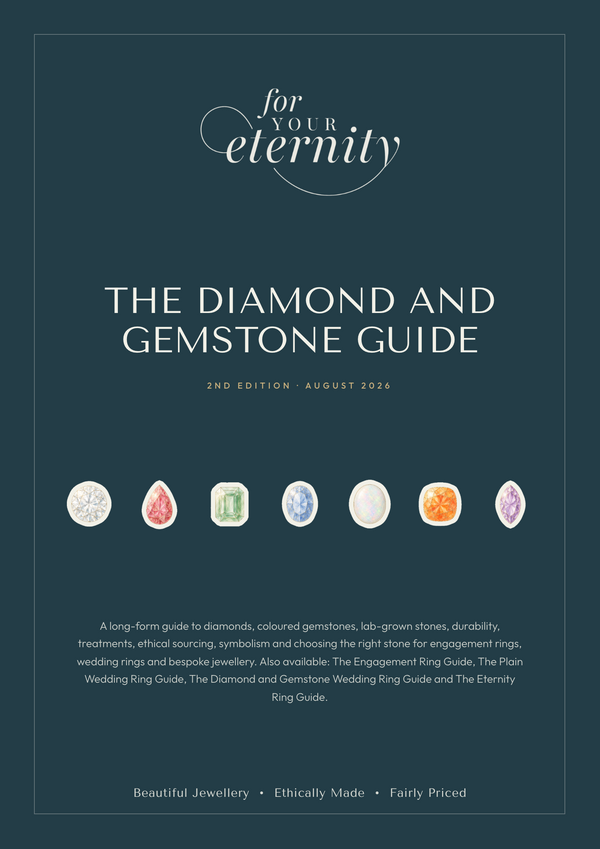
Diamonds, coloured gemstones, lab-grown stones and choosing the right stone for your ring.
Cleaning, safe storage, claw and setting checks, replating and when to have a ring serviced.

Fair, transparent pricing, fixed before we make
Free, insured shipping
Free resize in the first year
Lifetime warranty*
Ethically sourced diamonds and materials


