

Ethical Diamonds: What They Are, How to Identify Them, and Why They Matter
Natural, lab-grown or recycled: an honest comparison of the three routes to an ethical diamond, how

Every jeweller has an ethics page. Most of them say the same things in the same words, and none of them tell you how to check. This one is different in one respect only: every commitment below is something we can show you, and at the end we list the things we deliberately do not claim. If you are choosing between jewellers, we would rather be judged on that than on adjectives.
At a glance
| Commitment | What we do | How you can check |
|---|---|---|
| 1. Responsible metals | Every metal is recycled or from suppliers certified to recognised responsible sourcing standards | Ask which applies to your ring; we will tell you |
| 2. Straight answers on certification | We tell you exactly which certifications apply to the materials in your ring, and never imply ones that do not | Ask us to name them; if we cannot, we do not claim them |
| 3. Documented stones | Independent grading reports (GIA or IGI) for every diamond; origin and treatments stated for coloured stones | Ask to see the report before you order; check the inscription against it after |
| 4. Made to order | Nothing is made until it is chosen; no unsold stock, no overproduction | Lead times of several weeks are the evidence |
| 5. Independently verified | Every ring is hallmarked at the London or Birmingham Assay Office, and we are members of the National Association of Jewellers | The hallmark is inside the band; any jeweller can read it. Our NAJ membership is listed on the National Association of Jewellers website |
| 6. Honest pricing | A quote is a quote; no pressure, no countdown, no surprise extras | Ask for a written quote and compare it like for like |
| 7. Aftercare | Lifetime warranty against manufacturing defects; free inspection and cleaning for life; one free resize within 12 months of delivery; a clear price for anything else | Ask what a specific job would involve; we will tell you |
Every metal we use, platinum, white gold, yellow gold and rose gold, is either recycled or sourced from suppliers certified to recognised responsible sourcing standards. Recycled precious metal is refined back to identical purity and hallmarked to exactly the same standard as newly mined metal, so choosing it costs you nothing in quality or price and takes new mining out of your ring altogether. If you want to know which applies to a particular ring, ask; we will tell you.
We tell you exactly which certifications apply to the materials in your ring, and we do not put logos on our website that we cannot explain. The difference between a jeweller's own certification and its suppliers' matters, and our guide to five questions to ask any jeweller about sourcing explains why.
Every diamond we sell, natural or lab-grown, comes with an independent grading report from a laboratory such as GIA or IGI, which states what the stone is and whether it was mined or grown. We will tell you what we know about the origin of any significant stone before you order. For coloured gemstones, we state origin where it is known and any treatment the stone has had, because both change how you should care for it and what you should pay.
We do not claim that a certificate solves the diamond supply chain. It does not, and we explain what it does and does not cover in Beyond the Kimberley Process. What we promise is transparency: ask, and you will get what we know, not what sounds good.
Want to understand the choices before you talk to us? Our free Diamond and Gemstone Guide covers natural and lab-grown diamonds, coloured stones and certification, and our ethical and responsible sourcing page has the longer version of this article.
Every ring is made to order. That is slower than selling from a tray, and it is the single most sustainable thing a jeweller can do, because nothing is made that will not be worn. It also means your ring is made in your size, your metal and your profile from the start, rather than adapted from stock. Every finished ring is hallmarked at the London or Birmingham Assay Office, which independently tests and stamps the metal so that its purity is a matter of record, not trust.
We are a small, consultation-led jeweller. Most of our clients talk to us before they buy, either remotely or face to face in London, and the conversation is about what suits you, not about closing a sale. A quote is a written figure you can take away and compare; there is no countdown, no pressure and no surprise at the end. If you would rather browse first, everything is on the site, and if you would rather talk first, we are easy to reach.
A ring worn every day for decades will need attention now and then: a resize as fingers change, a polish, a re-plating for white gold, a claw checked. Every piece carries a lifetime warranty against manufacturing defects. We will inspect and clean it free for as long as you own it, and the first resize within 12 months of delivery is on us. For anything else, we tell you what the job involves and what it costs before we touch it. The sustainable outcome is a ring that stays in use, and aftercare is how that happens. Our free Ring and Jewellery Care Guide covers the day-to-day.
We do not claim to have solved the diamond supply chain, or that any single document proves a stone's whole history. We do not claim that lab-grown diamonds are automatically the ethical choice, or that natural ones are; our guide to ethical diamonds gives both a fair hearing. And we do not put logos on our website that we cannot explain. If you ever find a gap between what this page says and what you experience, tell us. We would rather fix it than defend it.
Put these commitments to the test. Ask us anything about a ring or a stone, or arrange a face-to-face meeting in London. Or start with our engagement rings, wedding rings and eternity rings.
It depends on the ring. Our metals are recycled or come from suppliers certified to recognised responsible sourcing standards, and every diamond carries an independent GIA or IGI grading report. Ask about a specific ring and we will tell you exactly which apply, and we will never imply one that does not.
Three things in practice: recycled or responsibly sourced metal so no new mining is needed for your ring, making to order so nothing is produced that will not be worn, and aftercare so the ring stays in use for a lifetime rather than being replaced.
Yes, and we have no preference. Both come with an independent grading report, and we will tell you what we know about any stone's origin. Which suits you depends on what you value: rarity and natural origin, or no mining and more diamond for the budget.
Every piece carries a lifetime warranty against manufacturing defects, free inspection and cleaning for life, and one free resize within 12 months of delivery. For anything else, such as re-plating white gold or re-tipping a claw, we tell you what the job involves and what it costs before we do it.
Natural, lab-grown or recycled: an honest comparison of the three routes to an ethical diamond, how
Ethical sourcing is not a badge on the box. It changes what you own: documented stones,
Online suits researchers, busy professionals and bespoke couples; a showroom suits those who need to see
Half eternity is the sweet spot for most people: full sparkle on show, comfort and resizing
Six expert guides: read online or take the free PDF, whatever stage you're at.
Budget, the Four Cs, diamond shapes, settings, sizing and bespoke design.
Profiles, metals, finishes, shaped-to-fit bands and matched pairs.
Eternity rings, setting styles, shaped-to-fit bands and everyday wear.
Full and half eternity styles, stone settings, spacing and how to wear them.
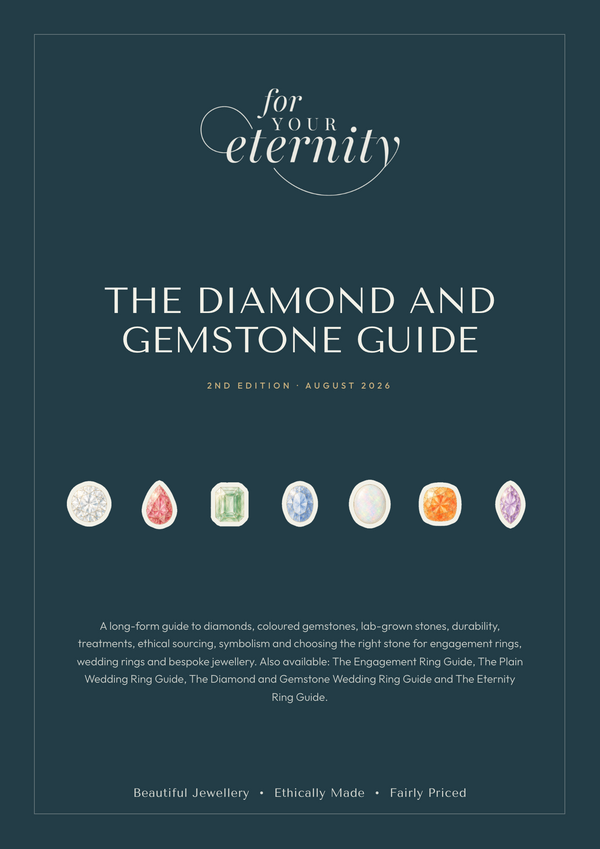
Diamonds, coloured gemstones, lab-grown stones and choosing the right stone for your ring.
Cleaning, safe storage, claw and setting checks, replating and when to have a ring serviced.

Fair, transparent pricing, fixed before we make
Free, insured shipping
Free resize in the first year
Lifetime warranty*
Ethically sourced diamonds and materials


